Image Map

Monday, July 18, 2016

Everything you ever wanted to know about using Interactive Notebooks in your classroom!

If you have been following me for a while, it should be no surprise to you how much I love using Interactive Notebooks in my classroom.  After first seeing them used in the Science classroom across the hall from me, I quickly fell in love - I loved the way they kept the kids organized, and how the kids had a record of their learning, that showed growth over time.  The next year, I began implementing them with my grade seven and eight students, and have not looked back.  

I will admit that this undertaking has been a huge work in progress.  I have had many hiccups along the way, but have found that the benefits have made all of the work worth it.  I have learned that Interactive Notebooks are certainly not just for elementary students, as my middle school students eagerly await opportunities to participate in anything interactive.  This different way of structuring our learning shakes things up a bit, which is exactly what a lot of my disengaged teenage learners need.  I am hugely passionate about using them with my students.

Research has shown many benefits to using Interactive Notebooks.  To me, the very best part of using Interactive Notebooks in my classroom is that they promote engagement, creativity, and analytical thinking - all things I strive for in my middle school classroom.  They keep my struggling students organized, make differentiating for my higher learners a breeze, provide a record of our learning, and become a student-created reference tool to refer back to when needed - honestly, I can't imagine how I ever structured my classes without them.

Lately, I have had a lot of people ask me about Interactive Notebooks, and how I use them in my classroom - sounds like a fun blog post to me!  I really wish I had few tips before getting started, as it would have caused me to bypass some of the wrong turns I made along the way.  


So... what are Interactive Notebooks, anyways?

I have seen Interactive Notebooks called many things - Reader/Writer Notebooks, Interactive Student Notebooks, Response Journals, etc.  Call them what you will, they are essentially a notebook of some sort that is used to record information.  The key is in the "interactive" part, which makes then fun and engaging - a hit with students of many different age groups.  Basically, Interactive Notebooks allow students to take information supplied by the teacher, and merge it with their own thinking.  The foldables and activities within the Interactive Notebook allow students to work with information they have gathered, creating deeper connections to the content.  Instead of just taking passive notes, students are encouraged to "show what they know" by applying their knowledge in a creative way.

In "Classroom Instruction that Works", Marzano, Pickering, and Pollock state that "taking notes and summarizing information is a proven thinking strategy that helps to increase student achievement and retain new information".  Providing students with information and then asking them to use thinking strategies to actually interact with it in some way helps the information to stick in their brains much more than simply listening to a lecture or taking notes from the board.  Creating the foldables and activities within the Interactive Notebooks increase student abilities to organize and connect to class content.  

In my past few years of using Interactive Notebooks in my middle school classroom, I have discovered the following benefits:


Interactive Notebooks are powerful educational tools.
Interactive Notebooks enable students to be creative and independent thinkers and writers.  They allow students to express their ideas in unique and engaging ways, and process information presented in class; as students learn new ideas, they have the opportunity to use several types of interactive writing and graphic techniques to record and process them.  The ultimate goal of using Interactive Notebooks in the classroom is to teach students to be independent thinkers and note takers; Interactive Notebooks teach students about the tools and strategies needed to eventually do this on their own.  The activities completed in Interactive Notebooks are so much more than cutesy cut and paste images; instead, they teach students to interact with content at a high level, and to make that content their own.  


Interactive Notebooks meet the needs of a variety of learning styles.
Interactive Notebooks allow visual learners to explore new ways to share ideas, and encourages non-visual learners to become more proficient with graphic approaches in a non-threatening way.  Both types of learners use the notebooks to work on their writing skills, while learning valuable note taking strategies.  I have found that my kinesthetic learners enjoy moving around and using their hands to assemble the bits and pieces.


Interactive Notebooks help students to systematically organize while they learn.
Students use Interactive Notebooks to organize their thoughts and ideas.  A variety of organizational techniques are used to synthesize concepts and help make sense of what they learn.  The notebook allows assignments to be kept together in a regular place and in a logical order.  Students who struggle with organization (and I am sure you have as many of those as I do!) often find the notebooks very helpful.  Instead of a million random worksheets, students have everything organized together in one place.  Our Interactive Notebooks cause us to spend a significant amount of time in class teaching these organization skills, which students are able to take with them into other subject areas.


Interactive Notebooks become portfolios of individual learning.
These creative notebooks become records of each student's growth.  The teacher, student, and parents can use the notebooks to review a student's progress in writing, illustrating, recording, thinking, and organizing.  They are an amazing portfolio to pull out during parent conferences.  Gone are the days of gathering up and storing assignments, as now I simply have to pull out our Interactive Notebooks to show parents what we have been up to.  These notebooks are an excellent summary of our learning, and parents always seem to be impressed.  Student growth can clearly be seen as they progress throughout the school year.


Interactive Notebooks are a work in progress, and allow students to learn from their mistakes.
I have my students complete a new notebook at the start of each unit.  Throughout the unit, notebooks are collected sporadically, and checked for completion.  When improvement is needed, sticky notes with constructive criticism are added.  As the notebooks are not collected for marks until the very end of a unit, students have multiple opportunities to receive feedback and improve their work before receiving a final mark.


Interactive Notebooks are valuable study tools.
As all of the information needed for each unit is contained inside the Interactive Notebook, the notebooks become comprehensive study guides created by the students themselves.  Interactive Notebooks help teach students new ways to study, and the activities within the notebooks often provide students with visual pictures to help remember content.  Having everything complete, organized, and in one place makes studying much easier.  Interactive Notebooks also teach students to be resourceful - when they get stuck in class, or forget how to do something, they can refer back to the information they have previously gathered.  They quickly become the "go to" resource  for students to go over concepts they have missed or are struggling with.  Throughout the course of the year, students are essentially creating their very own textbook; I can guarantee these self-created textbooks are much more meaningful to students.


Interactive Notebooks are fun, hands on, and engaging.
The activities we complete while putting together our Interactive Notebooks bring with them high levels of student engagement.  The kids are actively involved, moving around, and being creative while creating things that flip, flap, and fold - these hands on activities really give students the opportunity to grasp concepts further.  Interactive Notebooks turn the boring necessity of note taking into something kids actually look forward to.  No one remembers doing a boring worksheet, but I can guarantee you that my students can look back in their notebooks and remember completing each activity.  This engagement really helps them to remember concepts better.  When kids enjoy using these methods for note taking, they are much more likely to use them as a study and reference tool.  


Interactive Notebooks allow students to develop pride and ownership over their work.
According to research on Interactive Notebooks, they are most beneficial when they are used as a learning tool developed by students, for students.  Through the creation of our Interactive Notebooks, students actively interact with content, providing records of their learning.  Essentially Interactive Notebooks become records of learning that are physically put together by the students. Because of this, students take ownership, and are proud of the work they put into their Interactive Notebooks.  They spend a lot of time creating them, take care of them, and want to share them with others.  Very, very rarely have I had an Interactive Notebook go missing, even though I let my students take them home with them.  My students regularly spend their free time coloring them up, and they become beautiful and personal records of their learning.  When students create something they are proud of, they are much more likely to use it as their "go to" resource.


Interactive Notebooks are great for teachers, too!
Using Interactive Notebooks in our classrooms allow us reflect on our student's learning styles, as they are a great way to analyze student understanding of new concepts.  Many of the activities we complete in our Interactive Notebooks are perfect examples of formative assessment.  As teachers, we can then use the information we have gathered to create, plan, and manage our small group instruction.  The Interactive Notebooks I use in my classroom show everything we learned, when we learned it, and how we learned it.  As the year goes on, I make notes in my teacher version of areas we struggled and areas that went well.  This makes lesson planning so much easier the following year!

I really hope this post inspires you to give Interactive Notebooks a try in your classroom.  They are a surefire way to increase student engagement, organization, and accountability in your classroom.

Do you use Interactive Notebooks in your classroom?  If so, I would love to hear about it!  Tell me about how you use them by leaving a comment in the comment section!

Wednesday, July 13, 2016

Exploring Gary Paulsen's Hatchet


Hatchet by Gary Paulsen is one of my very favorite novels to teach.  I am always on the hunt for ways to pull in my struggling boys, and the male protagonist and survival theme really seems to suck them in.  The book is also one of my eleven year old daughter's all time favorites, so I can say with all honesty that the story is really appealing to adventurous young girls as well.

There is so much that you can do with this novel.  It makes a great literature circle book, as it pairs really nicely with other survival themed novels, such as Scott O'Dell's Island of the Blue Dolphins, Jean Craighead George's Julie of the Wolves or My Side of the Mountain,  Shipwreck or Everest by Gordon Korman, Deathwatch by Robb White, The Cay by Theodore Taylor, or The Girl Who Owned a City by O.T. Nelsen.  The similar themes of these stories would make for some great class discussion and compare/contrast activities.  

Youtube has some great videos about the novel.  I usually use an interview with Gary Paulsen that I found on youtube to introduce the author.


I like the way he talks about his life as a writer and his reasons for writing.  To keep the kids focused while we watch, I like to handout a few quick questions for them to complete while watching.  We glue these in at the beginning of our Hatchet Interactive Notebooks, and discuss the answers as a class.  If you would like a set of the questions we use (with answer key and video link), you can download it for free at my Teachers Pay Teachers Store here.

As the theme of the novel revolves around survival, I like to introduce the novel by discussing some wilderness survival tips.  I have collected a variety of tips on a handout, and we go over the tips and discuss them as a class.  After discussion, I have the kids brainstorm and write about the tip they think is most important.  The kids always enjoy this, and I find it to be a fun pre-reading activity to get them excited about the book.  We usually get some pretty good class debates going on, as the kids like to argue over which tip is most important.

In the past, I have had the kids complete chapter questions when we complete each chapter of the novel.  I like these questions in particular because they include vocabulary words and opportunities for the kids to express their learning in an artistic way.  This has been a good way to work on their vocabulary and to make sure they are understanding what they are reading.  

This past year, however, I decided to switch things up a bit.  We had been learning about summarizing, and I really wanted the kids to get some practice with these skills while reading through the novel.   To do this, I decided to have them summarize and illustrate what happens in each chapter.  This was a nice break from chapter questions, and the kids like the opportunity to show their understanding in artistic form.  I also really loved how the completed projects looked!  We hung them on the wall outside our classroom for a bit, and then glued them into our Hatchet Interactive Notebooks.

  
The little image on the left of Brian with mosquito bites makes me giggle every time I see it.  The kids had so much fun with these and I really love how they turned out.

As we progress through the novel, we spend a significant amount of time brainstorming the ways Brian has changed from the beginning of the novel towards the end.  I have them do a compare and contrast organizer in small groups, which we then go over and add to as a class.  When we are done, I have them glue them into their Hatchet Interactive Notebooks, as they will need to refer back to them for the next activity.

For this activity, the kids are required to illustrate and discuss the changes that Brian went through during the novel.  It makes for a great visual representation of Brian before and after.  I like the way this assignment forces kids have to look at the changes that occurred in Brian both on the inside and outside.  Again, the kids loved being able to use art to show their understanding, and I love how they turned out.  Once they were complete, we glued them into our Hatchet Interactive Notebooks.

If you are interested in picking up any of the resources shown in this post, you can pick them up at my Teachers Pay Teachers store by clicking here or on one of the images below.


Do you teach this novel in your classroom?  I would love to hear about some of the activities that work for you!

Monday, July 11, 2016

Silent Reading in the Middle School Classroom

As teachers, we all know the correlation between the amount of time that kids spend reading and their reading levels; quite simply, the more kids read, the better they will be at it.  Studies consistently show the key role that reading volume plays in the development of comprehension, vocabulary, general knowledge, and cognitive structures.  In Reading in the Wild, Donalyn Miller states that "we cannot overlook one truth: no matter what standards we implement or reading tests we administer, children who read most will always outperform those who don't read much".  Even though we know this to be true, I have found that many teachers struggle with fitting in independent reading time in their classes.  With standards to meet and tests to prepare for, independent reading is often something that falls to the wayside... and this is so sad!

Why should independent silent reading be practiced in our classrooms?

In his book, "Building Student Literacy Through Sustained Silent Reading", Steve Gardiner states that "a significant number of research studies have examined sustained silent reading programs, evaluating their effectiveness with students from primary grades to graduate school... and most of these studies show that SSR is successful in promoting and improving student literacy".  Later is the book, he goes on to state:

"Giving them time to read is clearly the most important thing I do with my students.  It:
-builds vocabulary;
-connects to writing;
-develops an understanding of the qualities of good readers;
-meets needs the teacher might not know about; and
-gives students a chance to connect with reading is an unstructured situation."

Every time our students pick up a book, they are faced with new ideas, words, and sentence structures.  Every minute spent reading builds upon the next, making reading easier and more enjoyable for our students.

Some of the additional pluses I have found while allowing my middle school students time for silent reading include:

-Opportunity for student choice - Most reading done is school is assigned.  Independent silent reading allows students to read material they choose on their own.

-Builds reading confidence - As silent reading time is meant to be uninterrupted, they must work through trouble spots on their own, which helps them to become confident readers.

-Students actually want to read more - Reading, sharing, and talking about books in a positive way encourages students to want to try new genres, experience different authors, plow through the next book in a series, and ultimately read more!

Some tips for setting up a silent reading program in your classroom.

As you can probably tell, I am a huge advocate for silent reading in my middle school classroom.  For the past 10 years, I have been having my students complete 10-15 minutes of independent reading time at the beginning of each class.  I will admit that it took a lot of trial and error for me before I turned silent reading time into something I felt was both beneficial and personally meaningful to kids.  Below, I have included some of my best tips and tricks for setting up a successful silent reading program for middle school learners.

1) Make the time - With all of the other things we have going on as teachers, it can be difficult to carve out an additional 10-15 minutes of class time in our already busy schedules.  However, with all of the research showing how effective independent reading is in the creation of life long readers, we really do need to find a way.  This reading time gives the kids the opportunity to actually apply all of the reading strategies and skills that you have been teaching them, and is crucially important.  Once you have found the time in your schedule, make sure you make the time a priority.  Kids need to see that this time is valuable and important, and won't learn this if you cancel it when "more important" things come up.  Show the kids that their reading time is worthy of protection, and never sacrifice it.

2) Allow for choice - As most of the reading kids do in school is assigned to them, independent reading time is the perfect opportunity to let them make their own choices about what they read.  Many teachers at the school I previously taught at would allow students to bring in their own books from home for this, or would give students time to sign books out from the library.  In my room, however, I have my students select books from our classroom library.  My classroom library is quite extensive, with a wide variety of authors, genres, lengths, and reading levels.  I am an avid Young Adult literature fan, so the added bonus of having the kids choose from our class library is that I have actually read all of the novels myself.   This allows me to have great discussions with the kids about what they are reading, and also helps me to make recommendations to kids who are struggling with finding the right book.  Because I have read all of the books, I know that they are quality literature choices, that are highly engaging.  Yes, this does mean that I require myself to read YA lit like a madwoman, seeking out the best new titles.  And it means that I spend quite a bit of money on investing in quality books for my classroom.  But, as this is something I really think is important, I make the time and find the money.  I will discuss some tips and tricks for setting up your own classroom library, and some of my favorite book choices for middle school kids, in an upcoming post.

3) Provide time for discussion - At the end of your 10-15 minute silent reading time, allow some time for class discussion.  This doesn't have to happen at the end of each silent reading time, but it is great if you can make an effort to do this a few times a week.  This is a great time to bring the class together and show them what you have been reading, introduce a new author or genre, or to give a quick book talk on a few new titles you have picked up for your classroom bookshelf.  You can have students share some of their favorite reads as well, or even have a guest staff member or parent come in and talk about one of their current favorites.  Our school librarian is always game to come in and share some of her favorites, and I have even had our principal come in and give a quick book talk.  These discussions can really motivate other students - I have found that kids will often choose their next reading choice based on recommendations by their peers, and a new book I have shared in class rarely sits on our book shelf for long.  It is amazing what a little advertising can do!  Allowing time to talk about books shows kids that reading isn't just a solitary activity.    

4) Celebrate Reading! - Sometimes reading can get a bad rap.  Kids can come into your classroom saying that they hate reading, and that it isn't something "cool".  As a teacher of reading, it is your job to make reading cool again!  Make reading in your classroom something to celebrate.  Give book talks, hold mini conferences with your kids to talk about what they are reading, and get excited about new books in your classroom library.  Your enthusiasm about reading really will rub off on them!  One of my favorite ways to celebrate reading in my classroom in by throwing a "book feast" at the end of the year.  Have your students choose a favorite independent reading book, and bring in a themed snack to share with the class.  On the day of the feast, have the kids discuss their books and the way the snack ties in.  I clearly remember a group of boys one year who were hooked on the "Hunger Games" series - they brought in "Cinna"-buns (cinnamon buns), Nightlock Berries (blueberries), and Po-"Cato"-Chips (potato chips).  Such a fun way to get kids excited about what they are reading, and to share that enthusiasm with others.

5) Model, model, model! - According to Gardiner, independent reading time "allows an adult to model the habits, choices, comments, and attitudes good readers develop".  Kids need to see that reading isn't just something that kids are assigned to do, but something that is enjoyable to adults too.  It can be very, very tempting to use this quiet classroom time to get some much needed work done, but try not to.  Pick up a book, practice what you preach, and show kids you value the time as well.

6) Hold the kids accountable - I know some of you will disagree with me on this one, and it is probably the area that I most struggled with when setting up my silent reading time.  I am all for reading for reading's sake, and fully agree that reading with a mandatory worksheet attached can suck the joy out of a reading experience.  That being said, kids are kids, and not all of them are going to buy in right from the start.  I found that without the accountability, I had some kids who would hide their phones and text behind their novels, or who would simply grab the first book they came across each day, resulting in them reading the first two pages of about 30 different books on our shelf.  They were not investing their time in a novel, and therefore could not get excited about them.  The way I stopped this from happening was that I created a series of Reading Comprehension Strategy Poster pages.
At the start of the week, the kids pick up a new reading comprehension strategy page from the front of my room, along with their silent reading book.  Throughout the week, the kids are required to work on these during their silent reading time.  Each page contains a few questions that can be applied to any novel they are reading, and which focus on specific reading comprehension strategies.  They can work on these at their own speed throughout the week.  The pages should really only take them 10-15 minutes to complete, so they don't take very much time away from their actual reading time, which I think is really important.  When the kids are done, I have them glue them into their Reader's Notebooks.  These are great to have on hand to refer back to when we talk about the different reading comprehension strategies in class, and give the kids some additional practice with these essential skills.
Then, throughout the week during our independent reading time, I call a few students up to my desk for a quick conference.  I keep the conference very low key, and simply talk to them about what they are reading and have them show me their completed reading comprehension strategy pages in their Reader's Notebooks.  This really helps to keep the kids accountable to what they are reading, and has made a huge difference in the success of my independent reading time.  I think that engaging the kids with what they read really helps them to think about and make sense of what they are reading.  If you are interested in trying out these reading strategy pages with your own class, you can check them out in my Teachers Pay Teachers store by clicking here or on one of the images I have included.

7)  Allow kids to give up on a book - When we read as adults, we will often stop reading when a book doesn't interest or engage us.  Let kids have the right to do this too!  As I mentioned above, I really don't like to see a kid picking up a new novel each day only to read two pages, but if a kid has honestly given a book a try, and has not found it enjoyable, they should be free to pick something else.  Independent reading time is supposed to be fun, and kids should be thoroughly enjoying what they choose to read.  Having a large classroom library, and the ability to recommend the right book to the right student, greatly reduces the amount of books kids give up on.

8) Provide Flexible Seating - Whenever possible, allow kids to sprawl out and really get comfortable with their books.  Bring is comfy cushions, exercise balls, or anything else you can get your hands on to facilitate this.  If it is a nice day, and your administration is on board, you can even take them outside to lay in the grass.  In the past I have been known to bring in a class set of yoga mats, move the desks out of the way, and let the kids lay out on the floor.  While I haven't let the kids set up blanket forts just yet, I wouldn't be opposed to the idea!

I certainly wouldn't argue about the importance of many of the things we do in our classrooms on a regular basis - in depth novel studies, writing instruction, and group work are all essential parts of the language arts classroom.  Clearly, however, we can see the importance of getting books into our students hands, and for allowing them to read independently during the school day.  No matter what instructional methods we choose to use, our students need time to actually apply the reading strategies and skills we teach if we want them to become skilled readers.  To do this, our kids need time to read!   Silent reading time is really just another tool in our arsenal for developing life long readers, who thoroughly enjoy the reading process.

Sunday, July 10, 2016

Summertime Reading and a Big Change!

As my 10th year teaching English and History to grade 7-9 students at the same school comes to a close, with it comes a big change.  Next year, I have decided to take a two year leave from my current job, and will be going to work as a Literacy Helping Coach with our districts's curriculum department.  They will be filling my old job with a temporary teacher for two years, so after that I can decide if I want to go back to that job, or apply for an additional two years with the curriculum department.  This will be a huge change for me, and it will be really strange not setting up my classroom for September, but I am super excited about the new opportunities this new position will bring.  

Do any of your guys work in this capacity?  I would love to hear about your experiences!

With the new job comes a large amount of summer reading - so many professional reads I have been wanting to get caught up on!  My office "summer reading" bookshelf currently looks like this:
I think I am going to busy :)

I generally read quite a bit during the school year, but as my time is so much more limited, I don't read nearly as much as I would like to.  I tend to use my summer to make up for this, and have always spent a significant amount of my summer days reflecting on the past year and brainstorming new strategies.  Currently, I am plowing through Carol Ann Tomlinson's "Leading and Managing a Differentiated Classroom".  I had heard great things about this book, and that it is essentially many people's "Go-To" when it comes to differentiating in their classrooms.  Reading it has really made me reflect back on my last year's class, and ways that I could have structured things a bit differently.  I had quite a few gifted kids last year, and this book has some great strategies that I could have used to challenge them a bit more.  If you take a close look at the picture of my copy that I included below, you can see a bunch of the sticky notes I have coming out of the top with ideas I want to come back to.  The book is well worth the read if you haven't had a chance to pick it up yet.

On my wish list is Jennifer Serravallo's "The Reading Strategy Book", and David Burgess's "Teach Like a Pirate".  I have heard great things about both, and am looking forward to adding them to my book pile.

Have you read any of these books?  Let me know which ones are your favorites!

Friday, July 8, 2016

Text Mapping Adventures - and a Freebie!

Text Mapping is a technique that can be successfully used to teach reading comprehension, writing skills, study skills, and course content. As an alternative to books, Text Mapping is completed on large paper scrolls.  Students take their reading and tape the pages together, creating a scroll that can be rolled out onto the floor.  This lets kids see the text in its entirety, instead of flipping through multiple pages. Having the entire text visible at one time, instead of just two open book pages, helps students to make connections across the lesson that they wouldn’t normally be able to make. Students are able to see the text as a whole, instead of focusing on individual parts.

To begin the activity, the first thing you need to do is gather a few pages of non-fiction text.  I usually use a photocopied section of our Social Studies textbook, on a unit we are about to cover.  This is a great pre-learning activity, as it allows the kids to work with the text for a bit before we begin our unit.  This time, I used a few pages of informational text that I had previously typed up, relating to Archaeology.  Our textbook doesn't go into enough depth on this topic, so I usually use this as supplemental reading.  It worked perfectly for this activity.

After you have gathered the pages you want to use, simply tape them all together into a long scroll.  You can have your students do this, or you can do it yourself before class starts to save on time.
After creating their scroll, students use a variety of different colored pens and highlighters to mark up the text in ways that are relevant to their reading purpose.  The strategies students use to map the text are similar to the ones they would use while close reading.


A big perk of Text Mapping is that it is a reading strategy that is easy to learn and implement, and also requires very few materials.  All the supplies you need for a successful lesson are a few pages of photocopied non-fiction text, some tape, and some colored pens and highlighters.  
According to textmapping.org, there are 7 key benefits to using text mapping in the classroom.  

1)  Scrolls and Text Mapping are explicit - teachers can model comprehension strategies so students can see exactly what comprehension looks like and how it is achieved.

2)  Scrolls and Text Mapping teach students to be strategic readers.

3)  Scrolls and Text Mapping encourage students to develop active reading skills - students must move around the scrolls and mark up the text.

4)  Scrolls and Text Mapping enable comprehension to be linked directly, explicitly, and concretely to the text - this ensures that comprehension will be reliable, accurate, and complete.

5)  A text map is a traceable visual record of an individual's thought process - you can see exactly where the thinking is happening.

6)  Scrolls and Text Mapping accommodate a wide range of learning styles.

7)  Scrolls and Text Mapping can be particularly helpful to individuals who have learning disabilities or attention deficits - scrolls are more accessible to a greater range of senses and learning abilities.

If you are looking for additional information on this fun strategy, I highly suggest you check out textmapping.org.  There is a ton of great information!
Interested in trying this out in your classroom?  All of the resources I used to complete this activity are available for free from my Teachers Pay Teachers store.  The package includes information on what text mapping is, a step by step guide for using it in your classroom, a non-fiction article with questions that can be used for text mapping, and several different variations of activities for students to use while text mapping, suitable for both elementary and middle school students.  If you decide to use it, please leave me a comment and let me know how it works for you!


Do you use text mapping in your classroom!  Leave me a comment and tell me all about it!

Tuesday, July 5, 2016

Close Reading - Tips and Tricks

I was first introduced to Close Reading at a professional development workshop a few years ago, and it has since become a huge part of my teaching practice.  Repeated readings and annotation of complex text has helped to deepen student understanding and allowed students to make real life connections to what they are reading.  Instead of rushing through text, as my students often do, students learn that some texts require multiple readings to fully understand.  When we read something for the first time, we may notice some things, but not all; sometimes texts require a second or third look to really grasp what is going on.  We, as teachers, need to show students that certain texts are worthy of that level of attention.

What is Close Reading, and why is it important? 

According to Close Reading gurus Fisher and Frey, Close Reading is "an instructional routine in which students are guided in their understanding of complex text".  Basically, Close Reading is an instructional approach that integrates several reading strategies, where students add knowledge gained from text to their schema. Doing so builds habits of successful readers, and builds stamina and persistence with complex text.

Close Reading, however, is not a complete reading program.  It is best to think of it as another tool in your teacher toolbox.  It works best for complex texts.

In order to close read a text, students must:

-interact with the text
-read strategically
-reread the same text multiple times to uncover layers of meaning that lead to deeper understanding
-focus on the author's message
-analyze multiple components of the text and illustrations
-use their annotation skills
-answer text dependent questions
-use text evidence to defend ideas

According to Fisher and Frey, "the primary objective of  a close read is to afford students with the opportunity to assimilate new textual information with their existing background knowledge and prior experiences to expand their schema".   Both Fisher and Frey agree that close reading needs to be done alongside other essential instructional practices, as these are vital to reading development.  These practices include shared reading and instructional read alouds, teacher modeling, think alouds, guided reading, collaborative reading, discussion, and independent reading and writing.


What are the key features of a Close Reading lesson?

There are six key features to a quality Close Reading lesson.  These include:

Short Passages - if the passage is too long, it becomes difficult for students to really dig deep.

Limited Frontloading - the cold read allows students to dive right into the text.

Text Dependent Questions - these encourage students to reread the text and facilitate conversations between students in small groups.

Repeated Readings - students should read text multiple times to aid understanding.

Complex Texts - texts should be above the reading level of most students.

Annotation - students should be taught to annotate text as they read to aid understanding.

The first step in Close Reading instruction is choosing an appropriate text.  The text should be short enough to not overwhelm the student and to allow students to really focus.  The text should also be complex enough to stand up to multiple readings - students should be challenged by the reading.  

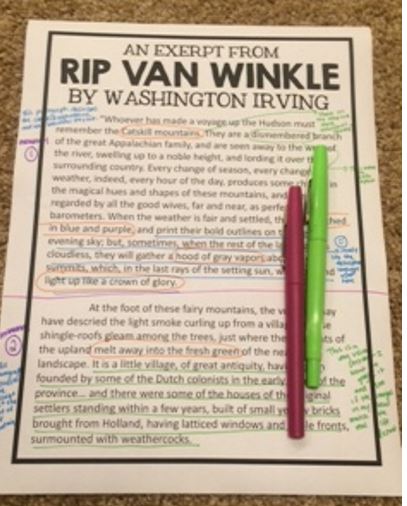
For each reading of the text, students should annotate.  They should underline key words, circle sections they don't understand, and write notes in the margin.  I love using different colored pens and sticky notes for this, as well as annotation symbols.  For a detailed handout showing the annotations that I have my middle school students use, check out my complete Close Reading package here.  The excerpt from Rip Van Winkle that we are annotating in this image is also included in the package.

How does the small group discussion piece of close reading instruction work?

An essential part of a close reading lesson includes small group discussions.  This allows students time to discuss the text in detail, and helps them to uncover important things they may have missed.  I have also found that the small group discussions break things up a bit, making the process a bit less taxing on the students - they love an opportunity to chat with their classmates, and as long as they are focused on the learning outcomes I am happy to provide time for it.

Close reads can be divided into four basic phases. Students will read the text before each phase, allowing for repeated readings of the text. 

 Students should discuss with their small groups during each phase. to facilitate understanding.

1) What does the text say?  This involves the general understanding of the text and key details.
2)  How does the text work? This involves students looking closely at the author's craft, vocabulary, and structure.
3)  What does the text mean?  This involves the author's purpose behind writing the text.
4)  What does the text inspire you to do?  This involves extended writing.

Through these 4 phases, students have the opportunity to fully immerse themselves in the text, allowing for deeper understanding.


I have spent a significant amount of time recently reading about what the experts think about Close Reading, and ways it can be used in the classroom.  I highly suggest you check out some of the books below to add to your professional reading library.
Falling in Love with Close Reading - Christopher Lehman and Kate Roberts

Text-Dependent Questions, Grades 6-12: Pathways to Close and Critical Reading - Douglas Fisher and Nancy Frey

A Close Look at Close Reading: Teaching Students to Analyze Complex Texts - Barbara Moss and Diane Lapp

Close Reading and Writing from Sources - Douglas Fisher and Nancy Frey

Illuminating Comprehension and Close Reading - Isabel L. Beck and Cheryl Sandora

Notice and Note: Strategies for Close Reading - Kylene Beers and Robert E. Probst

If you are looking for some great close reading resources to use in your classroom, I encourage you to click on the images below or check out my Teachers Pay Teachers store - I have a variety of engaging close reading resources available.  All of the resources have been used successfully in my middle school classroom!


Do you use Close Reading in your middle school classroom?  Leave me a comment - I would love to hear about what works for you!

Monday, July 4, 2016

The All Time Best Short Stories for Middle School Students!


Short stories definitely have their place in the middle school English classroom.  These short works of literature can grab a reader's attention right from the start, making them great for reluctant readers, whose patience and attention spans can often run short; while they can be enjoyed by all students, they are perfect for the kids who are unable (or unwilling) to tackle an entire novel.

Great short stories can be used to teach literary elements and critical thinking skills, and lay the groundwork for engaging classroom discussions and writing assignments.  Many of my favorite short stories have twist endings, and are great for teaching careful reading; while the endings often jolt the reader, the author usually gives enough hints along the way to give the reader the chance to figure out what is going to happen.  It is hard to beat a good twist ending when it comes to engagement. 

Too often I find that teachers limit the stories they use in their classrooms to those they can find in their classroom literature anthology.  There are so many amazing stories out there, just waiting to be taught!   As a true lover of the short story, I have dedicated my teaching career to collecting some of the very best, and have created my own personal classroom anthology.  As many full text versions of short stories can be found for free online, I simply googled the title of each of the short stories I wanted, made copies, and put them all together in a duotang.  I now have a classroom set of my favorites that I can use when the mood strikes, and can add (and subtract) new short stories as I discover them.

I have included some of my very favorite short stories below.  These are stories that I have used with my middle schoolers for many years - all are guaranteed to be highly engaging, and promise to raise questions and instigate great discussions in your classroom.  Included are links to online versions of the stories, so you can check them out yourself.  I have only included a quick blurb about each, as I don't want to spoil the stories for those of you who are yet to discover them.  

The Necklace - Guy De Maupassant

In this engaging short story, a woman borrows an expensive necklace from a wealthy friend, only to lose it.  She then spends the rest of the story trying to repay her debt.  With a surprising twist ending, this short work of classic literature is sure to engage your students.  The characters in this story are very well developed, and make for great lessons on characterization.  As the main character comes off quite spoiled and unlikable, it makes for an excellent class debate or writing assignment on whether or not she deserved her fate.  

Full text of the short story can be found here.

Lamb to the Slaughter - Roald Dahl

Roald Dahl is easily one of my favorite writers of all time. While his novels are amazing, his lesser known shown stories are equally as great.  "Lamb to the Slaughter" focuses on a scorn woman, who murders her husband with a frozen leg of lamb.  The rest of the story revolves around her trying to hide her guilt and conceal the evidence.  This is certainly a creepy story, but I think that is exactly what makes it so appealing to students of this age group.  I often use the story to teach persuasive essay writing, while having the kids debate about whether or not they think the main character should get away with the crimes.  After reading, I always make sure to show the kids the Alfred Hitchcock version of the story on youtube - Mary's giggle at the end is haunting!  

Full text of the story can be found here.

The Sniper - Liam O'Flaherty

If you are looking for a way to draw in your reluctant male readers, this short story is it.  With guns, war, and a little bit of violence, I found that it really appeals to a lot of the adolescent boys in my classes.  The story revolves around a sniper sitting on a rooftop during the Irish Revolution; he gives away his place while lighting a cigarette, and knows he has to escape.  The twist ending will leave your students open-mouthed, and always makes for great classroom discussion.  The unexpected ending is a great opportunity to teach irony.  I often integrate this story into my Social Studies curriculum, as use it as an introduction to our civil war unit.

Full text of the story can be found here.

Interlopers - Saki

I only recently discovered this haunting short story, but it has quickly become one of my all time favorites.  The story begins with the heads of two feuding families, hunting each other through the forest at night.  Just as they are about to shoot each other, a large tree falls in the snowy forest, trapping both of them beneath it.  The story has a great twist at the end that will leave your students gasping, making it a great story for teaching about irony and for reviewing plot.  I also love to use it for teaching character motivation; the story begins with the characters being motivated by hatred, which quickly changes to the opposite.  The misfortune of the events that unfold mature the men quickly, making a great teaching example of how empathy and understanding are the keys to conflict resolution.

Full text of the story can be found here.

The Chaser - John Collier

In this very short story a young man purchases a love potion, and is pleased to discover that it only costs a very small amount.  The merchant, however, has something more costly to offer him, should he need it in the future.  This is one of my favorite stories to teach in February, as the whole love potion idea pairs well with Valentine's Day festivities.  The story itself is only a page or two long, making it highly accessible to even your most struggling middle school readers.  After reading the story, students soon discover that the title is a great play on words, which makes for engaging class discussion.

For a full text version of the story, click here.  

The Story of an Hour - Kate Chopin

This story begins when a woman is given news that her husband has died in a railroad accident.  In the hour that follows, she contemplates her life while experiencing a wide range of emotions.  Another story with a twist (can you tell I love twist endings?), students are always caught off guard by the ending, leading to great class discussions.  The story easily lends itself to activities relating to symbolism, irony, and plot structure.

Full text of the story can be found here.

The Gift of the Magi - O. Henry

In this story, a young couple low on funds try to find a way to get each other a special Christmas gift.  This is one of my favorite stories to read around the holidays, as it has a beautiful message about giving, and the things we should value most.  It is a great story to pair with a reading of A Christmas Carol, and is also great for reviewing plot, character motivation, and irony.

Full text of the story can be found here.

A Sound of Thunder - Ray Bradbury

Set in the future, time travelers on a hunting expedition visit prehistoric times to shoot and kill a Tyrannosaurus Rex.  The story explores the concept of the "Butterfly Effect", where one small action in the past can have massive consequences in the future.  Students who have seen Groundhog Day will be familiar with the concept, but I find this story to be much darker.  I usually have students complete a plot diagram to go along with this story, and make notes on the actions of the characters that make an impact on future events.  This story is a bit longer than some of the ones I mentioned above, but I have found that the kids get hooked into the story right from the start, making them not mind the length as much.  This story is a great way to hook some of your reluctant adolescent boys.  This story pairs well with "Of Missing Persons" by Jack Finney, as both stories discuss the effects of time travel - although Finney's story is quite long, it is really one of my very favorites.

Full text of "A Sound of Thunder" can be found here.

Rain, Rain, Go Away - Isaac Asimov

Isaac Asimov is one of my favorite science fiction writers.  His stories often have twist endings, and just the right amount of strange creepiness to make them extra appealing to this age group.  When it comes to creepy and strange, "Rain, Rain, Go Away" does not disappoint.  In the story, the main characters are curious about their new neighbors, who seem to be acting strangely.  In an effort to get to know them better, they invite them on an outing to a local fair; after consuming massive amounts of cotton candy, panic ensues when an unforeseen rain storm catches the new neighbors off guard.  This is an excellent story for teaching cause and effect and character changes over time.  The story is also great for visualization, as the final scene really paints a picture in the minds of young students.  Because of this, I often have my students illustrate before and after pictures of the neighbors.

Full text of the story can be found here.

The Most Dangerous Game - Richard Connell

This is one of my favorite stories to teach about mood and suspense.  In this engaging and tense story, a well known hunter crashes his boat into an almost deserted island, only to discover that the inhabitant likes to hunt humans.  The beginning of the story is a great opportunity to teach students about how setting can help to create mood.  The descriptions in the story are very visual, and I often have my students draw maps of the island, and show where key plot events in the story take place.  This story is a definite favorite among middle school students.

Full text of the story can be found here.

Examination Day - Henry Seslar

Don't let the fact that this story was originally published in Playboy (!??!) stop you from using it in your classroom!  Its distopic version of the future makes it a hit with students interested in this genre. In the story, bright young Dickie is sent to write an exam that all children of the future must take.  The story ends with a jolting twist, and lends itself to some interesting classroom discussion and writing activities about the nature of intelligence.    

Harrison Bergeron - Kurt Vonnegut

I love pairing this story with Seslar's "Examination Day", as both stories are set in the future and discuss similar themes about intelligence.  In this story, the people of the future have been given "handicaps" to make sure that everyone is equal.  The story picks up when young Harrison Bergeron takes over a television program, revolting against the handicaps he has been given.  This story lends itself to a great discussion about political propaganda; I usually end the unit by having the kids create their own propaganda posters for the main character in the story.

A full text version of "Harrison Bergeron" can be found here.

All Summer in a Day - Ray Bradbury

When Margot moves from Earth to the rainy planet of Venus, she is bullied by the other children who are jealous of her for seeing the sun.  As the first sunny day the planet has seen in many years approaches, the bullying intensifies, leading up to a heartbreaking finale.  This is a great story to use when discussing bullying, as students tend to feel quite strongly for Margot, and can often make connections to their own lives.  As it is set on a distant planet, it is also a great story to use when discussing setting.  When we are done reading, I often show my students the movie version of the story, which can easily be found on youtube.  

The full text version of the story can be found here.

The Birds - Daphne Du Maurier

As this is the classic short story that Alfred Hitchcock's famous movie was based on, it makes for a great spooky story to use around Halloween.  In the story, the main character notices that the town's birds have been acting strangely.  Soon, he is forced to barricade himself inside his house, and fight to protect his family from the swarming birds.  The spooky nature of this story makes it a great one to teach mood and suspense.  As it is a longer story, I like to have my students practice their close reading strategies while reading, and annotate the text as they go along.  When the unit is complete, it is fun to show the students the classic Hitchcock movie, and compare and contrast the similarities and differences between the movie and story.  While it was considered to be quite a scary movie when it was first released, it is quite tame by today's standards, and I have no problem showing it in my classroom.  My students are so accustomed to the special effects of today's movies, that they usually find this movie quite hilarious to watch.

A full text version of the story can be found here.

The Elevator - William Sleator

This story revolves a young boy named Martin, and his overwhelming fear of an overweight lady who climbs into his apartment elevator every time Martin boards.  This is a great story to review plot, as the climax happens at the very end.  I have found that my students often struggle to locate the climax of the story when it happens so late in the text, and this is a great way to help them practice with this.  This story is definitely creepy, making it a hit with this age group.

A full text version of the story can be found here.

Hopefully you can make use of some of these fantastic short stories in your classroom!  I will continue to add to this list as I discover more favorites. 


Looking for some resources to use along with these stories?  This giant 88 page resource bundle is available in my Teachers Pay Teacher store, and contains 11 of my best selling short story resources, bundled together for a heavily discounted price.  Resources to use with a variety of short stories are included, as well as detailed activities and notes to go along with the elements of literature.  Perfect for your upcoming short story unit, this package has enough resources to keep kids engaged while learning about the literary elements.

This 88 page package includes:
-Short Story notes on the Elements of Literature
-Literary Elements Flip Book Project
-Short Story Poster Projects to go along with 10 different short stories
-Additional worksheets to use with any of the included stories
-Links to online versions of all stories
-Detailed answer keys for all assignments.


What are some of your favorite short stories to teach with middle school students?